

One of the most common questions I’m asked is “What are gradient factors and which ones should I use when diving?” I can help explain what they are and you can decide which gradient factors may be best for you. PLEASE NOTE THIS ARTICLE PROVIDES ONLY A BRIEF OVERVIEW OF GRADIENT FACTORS AND DECOMPRESSION DIVING. IT IS NOT A SUBSTITUTE FOR FORMAL TRAINING. YOU SHOULD COMPLETE A CERTIFICATION COURSE IN DECOMPRESSION DIVING BEFORE ATTEMPTING ANY DIVE REQUIRING DECOMPRESSION.
A Brief Review
Let’s start with a brief and very simple review of decompression theory. When scuba divers go underwater, their bodies absorb inert gas (mainly nitrogen) from the breathing gas. During the dive, the diver continues to accumulate inert gas. As the diver ascends, surrounding (ambient) pressure decreases and the accumulated inert gas is eliminated from the body through respiration.
If a diver ascends too quickly, nitrogen can form bubbles in tissues or blood, potentially causing decompression sickness (DCS).
Modern dive computers calculate safe ascents using decompression algorithms. One of the most common tools used to adjust these algorithms is called gradient factors (GF).
Although the term sounds technical, the concept is actually straightforward.
What Are Gradient Factors?
Gradient factors are a way to add safety margins to decompression models.
Decompression algorithms estimate the maximum amount of dissolved gas your body can safely hold at any depth. This limit is called an M-value.
Gradient factors tell your dive computer:
“How close to that theoretical limit am I willing to get?”
Instead of pushing the model to its maximum limits, gradient factors keep you below the limit for additional safety.
A Simple Analogy
Imagine the decompression model’s limit is like a speed limit of 100 mph.
- Driving 100 mph = maximum allowed by theory
- Driving 70 mph = safer buffer below the limit
Gradient factors simply tell the dive computer what percentage of the maximum limit to allow.
The Two Gradient Factor Numbers
Gradient factors are written as two numbers, such as:
- GF 30/70
- GF 40/85
- GF 50/90
Each number affects a different stage of the ascent.
GF Low – Controls the Start of Decompression
The first number is called GF Low.
It controls how early decompression begins during ascent.
Example:
GF Low = 30
This means decompression starts when tissue gas pressure reaches 30% of the model’s maximum limit.
Lower GF Low values mean:
- Decompression starts deeper
- More deep stops
- Often longer decompression
Higher GF Low values mean:
- Decompression starts shallower
- Fewer deep stops
- Shorter runtime
GF High – Controls the Final Ascent
The second number is called GF High.
It determines how close you get to the model limit when surfacing.
Example:
GF High = 80
This means the diver surfaces when tissues reach 80% of the allowed limit.
Lower GF High values mean:
- Longer shallow stops
- More conservative decompression
- Larger safety margin
Higher GF High values mean:
- Shorter decompression
- Less conservative decompression (more risk)
- Closer to the theoretical limit
How Gradient Factors Create a Safety Margin

What this shows
- The green line represents the theoretical decompression limit (M-value).
- Gradient factors keep divers below this line.
- More conservative settings create larger safety margins.
Where GF Low and GF High Apply During Ascent

This diagram shows:
- GF Low affects the early/deeper part of decompression.
- GF High controls the final ascent near the surface.
Example Dive Comparison
Two divers complete the same dive but use different gradient factors.
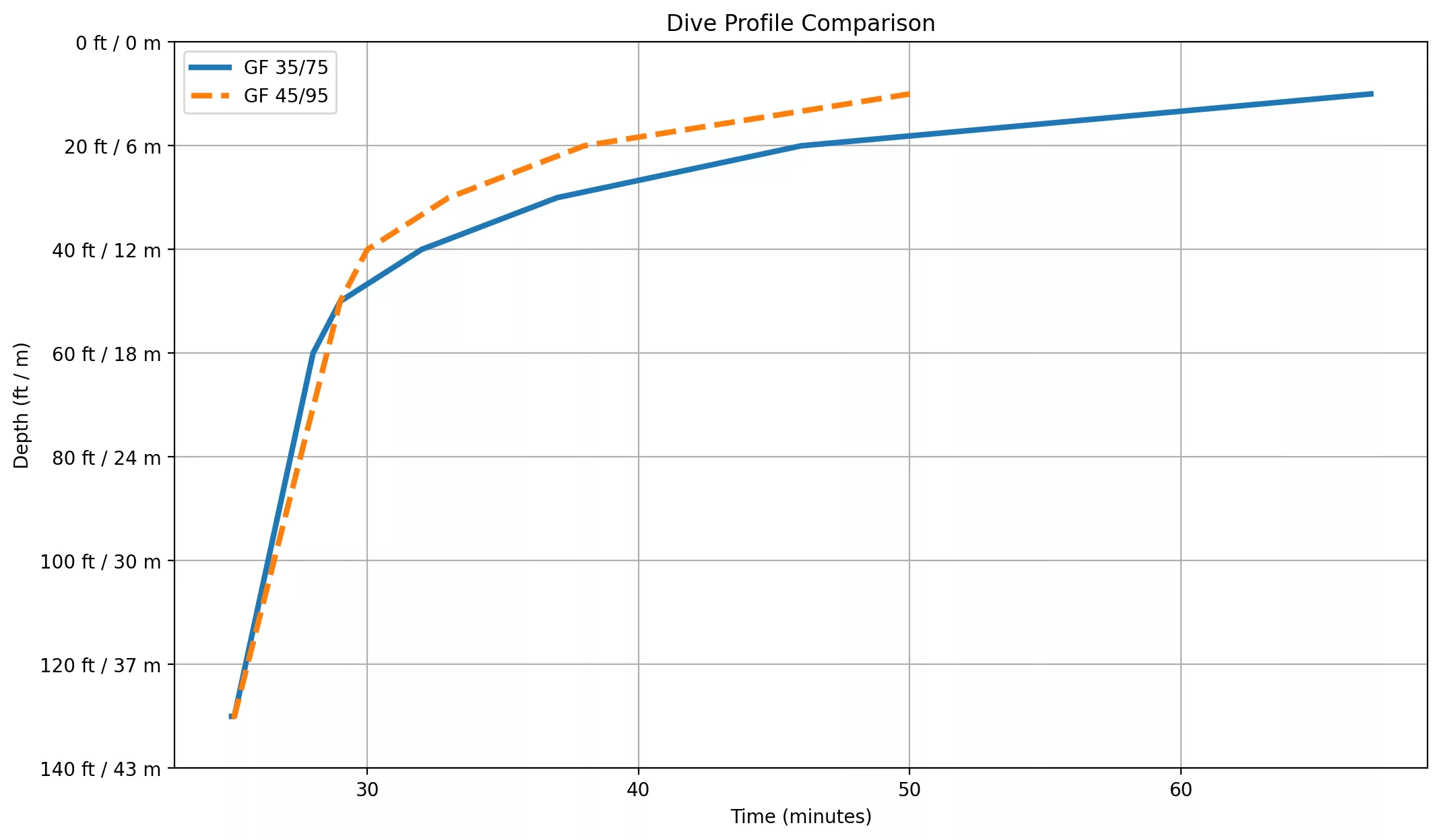
Diver A — GF 35/75
- Decompression begins earlier
- Deeper stops
- Longer total decompression
- More conservative profile
Diver B — GF 45/95
- Later decompression start
- Shallower stops
- Shorter runtime
- Closer to model limits
- Less conservative profile
Both dives may be allowed by the algorithm, but their safety margins differ.
Common Gradient Factor Settings
Shearwater Research Inc., a leading manufacturer of dive computers offers presets for Gradient Factor settings. Gradient Factors are also fully customizable for those who fully understand the concept of Gradient Factors and their impact on the decompression schedule and potential risk. These presets offer a good starting point.
| Gradient Factors | Typical Use |
|---|---|
| 35/75 | High Conservatism |
| 40/85 | Medium Conservatism |
| 45/95 | Low Conservatism |
Settings vary depending on:
- diver training and understanding of deco theory
- gas mixtures
- environmental conditions
- personal physiology
- risk tolerance
Why Gradient Factors Matter
Gradient factors are important because they allow divers to customize decompression conservatism without changing the underlying decompression model.
They help account for real-world variables like:
- cold water
- heavy workload
- dehydration
- fatigue
- individual physiology
Because decompression science is complex and still evolving, gradient factors provide a practical safety buffer.
Key Takeaways
- Gradient factors adjust how conservatively decompression models are used.
- They are written as GF Low / GF High.
- GF Low controls when decompression begins.
- GF High controls how close you get to the limit when surfacing.
- Lower values generally mean longer but potentially less risky decompression.
In simple terms:
Gradient factors are a safety dial for decompression planning, be conservative.
THIS ARTICLE PROVIDES ONLY A BRIEF OVERVIEW OF GRADIENT FACTORS AND DECOMPRESSION DIVING. IT IS NOT A SUBSTITUTE FOR FORMAL TRAINING. YOU SHOULD COMPLETE A CERTIFICATION COURSE IN DECOMPRESSION DIVING BEFORE ATTEMPTING ANY DIVE REQUIRING DECOMPRESSION.
References
Baker, Erik C. (1998). Clearing Up the Confusion About Deep Stops.
Bühlmann, A. A. (1995). Tauchmedizin: Diving Medicine. Springer.
Mitchell, Simon J., & Doolette, David J. (2013). Recreational Technical Diving and Decompression Illness.
Pollock, Neal W. (2015). Gradient Factors Explained. Divers Alert Network (DAN).
Vann, R. D., Butler, F. K., Mitchell, S. J., & Moon, R. E. (2011). Decompression Illness. The Lancet.
Technical Diving International (TDI). Decompression Procedures Manual.
Shearwater Research Inc. Petrel 3 Recreational Manual.